

 Current position > Product detail
『Oil Flow Meter Installation Guide: Upstream and Downstream Straight Pipe Run Rules』Related information(clamp on meter|electromagnetic meter|venturi meterrotameter|orifice meter|ultrasonic flow meter|mass flow meter|coriolis mass flow meter|coriolis flow meter|magnetic flow meter|magmeter flow meter|magflow flow meter|mag meter flow meter|electromagnetic flow meter|vortex flow meter|turbine flow meter|thermal mass flow meter|thermal flow meter|rotameter flow meter)

Oil Flow Meter Installation Guide: Upstream and Downstream Straight Pipe Run Rules
Quick Answer: For most oil flow meters you need 10 pipe diameters of straight pipe upstream and 5 diameters downstream. This rule keeps flow profile stable and measurement accurate. Short straight runs cause swirl and asymmetry that can shift readings by 2 percent or more, especially with viscous oils like heavy fuel or lubricating oil. If space is tight, flow straighteners help, but they cannot fully replace straight pipe.
Why Straight Pipe Runs Matter for Oil Flow Meters
When oil flows through a pipe, any bend, valve, tee, or reducer disturbs the velocity profile. The fluid does not travel in straight lines. It swirls. It creates asymmetric velocity patterns. A flow meter installed too close to these disturbances reads a distorted profile. The result is a permanent offset in flow rate or total volume. With oil products, the effect is often worse than with water because viscosity damps out turbulence slowly. At 50 centistokes or higher, swirl can persist for 30 to 40 pipe diameters downstream. That is why a straight run is not a suggestion. It is a calibration requirement.
Upstream vs Downstream Requirements
Upstream straight pipe conditions the flow before it enters the meter. This is the most critical section. Most manufacturers ask for 10D to 20D upstream, depending on flow meter type and the fittings before the meter. A single 90-degree elbow in one plane normally needs 10D. Two elbows in different planes, or a partially open gate valve, can demand 30D or more.
Downstream straight pipe prevents back pressure fluctuations and recirculation from disturbing the meter signal. Five pipe diameters downstream is standard. Less than 5D can cause cavitation or pressure wave reflections in positive displacement meters and Coriolis meters. In turbine and vortex meters, insufficient downstream pipe can amplify signal noise.
Minimum Straight Pipe Lengths by Flow Meter Type
Different oil flow meters tolerate different levels of flow distortion. Here are the real field numbers we tell our customers at Silver Instruments.
Oval Gear Flow Meters (Positive Displacement)
PD meters are the most forgiving. They mechanically isolate each pocket of fluid. A rule of 5D upstream and 3D downstream works in most installations. If you are measuring heavy fuel oil at low flow, even 3D upstream may be acceptable. We still recommend a simple straightener or at least 5D when possible. Visit our oval gear flow meter page for diesel and fuel oil models.
Coriolis Mass Flow Meters
Coriolis meters are mass-based, not velocity-profile-based. So you do not need long straight runs. In theory, 0D can work. In practice, vibrations and pipe stress can shift the zero, so we recommend 5D upstream and 2D downstream if there is a control valve nearby. We have seen a 0.3 percent zero drift on a crude oil loading skid in Oman just because the installer bolted the meter directly to a butterfly valve. Straight pipe plus flexible hoses solved it.
Turbine Flow Meters
These are the most sensitive to swirl. Oil passing through a turbine meter at an angle can over-register flow. Standard upstream length is 20D with a straightening vane, or 30D without. Downstream needs 5D. For lubricating oil blending, we often prepackage turbine meters with integral straighteners to save piping work.
Vortex Flow Meters
Vortex meters count vortices shed from a bluff body. Swirl changes the shedding frequency. Upstream 15D to 25D with straighteners is typical. Downstream 5D. Hot oil applications above 150 degrees Celsius require attention to thermal expansion of the straightening element. Silver Instruments can supply meters with built-in flow conditioners rated for high-temperature service.
Ultrasonic Flow Meters (Inline Type)
Inline ultrasonic meters for oil need 10D upstream and 5D downstream if there are no mixing elements. Clamp-on types have more flexibility but still need a fully developed flow profile. For heavy crude, we ask for 15D upstream because acoustic signals are already attenuated by viscosity, and added swirl causes signal loss.
Instal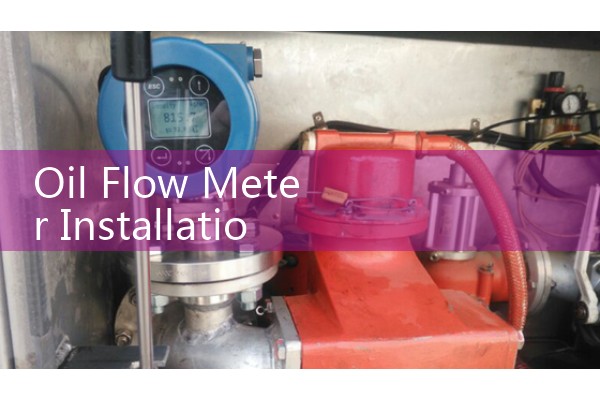
Most engineers skip this part, but in practice, few sites have perfect straight pipe. Here is what we see on customer sites from Vietnam to Mexico.
One common mistake is using flexible hose right before the meter to absorb vibration. The hose ID is often smaller and acts as a sudden contraction, creating a jetting effect. If you must use hose, install it after a straight spool of rigid pipe.
Another mistake is using a concentric reducer directly at the inlet. For oil, an eccentric reducer with the flat side down prevents air pockets and gives a smoother transition. That small detail can improve repeatability by 0.5 percent on viscous oils.
Also, do not install a strainer or filter right before the meter without straight pipe. The mesh generates fine-scale turbulence that fools many meters. Always put the strainer upstream of the required straight section. We learned this from a palm oil mill in Indonesia that kept getting erratic readings. The simple fix was moving the Y-strainer 10D away.
What If You Don’t Have Enough Space?
Here is the thing. Not every skid or pipeline has room for 20D. Flow straighteners or flow conditioners can reduce upstream length to 5D or even 3D in some cases. Baffle-plate conditioners work well with vortex and turbine meters. Tube-bundle straighteners are good for low-viscosity oils. For high-viscosity fuel oil, we test the flow conditioner with the actual fluid to confirm it is not just hiding the problem. Silver Automation Instruments can do a pre-installation flow simulation or advise based on viscosity, density, and Reynolds number. Tell us your space limit and we will figure out the shortest acceptable configuration.
Case Study: A Diesel Generator Test Bench in Malaysia
Last year a customer in Malaysia set up a flow test bench for diesel generators. He used a 4-inch (DN100) turbine meter. The upstream pipe had two elbows close to the meter inlet plus a butterfly valve. Total straight run was only 6D. The flow readings jumped 4 percent between tests even at steady flow. He added a tube-bundle straightener and increased the straight section to 9D. The variation dropped to 0.5 percent. He said it was the cheapest change that made the biggest difference. These kinds of stories are why we ask for photos of the piping layout when you request a quote.
Get a Quote for Your Oil Flow Meter Project
Straight pipe rules depend on your flow meter type, oil viscosity, and the fittings around it. Send us your pressure (bar), temperature (°C), pipe size (DN), flow range (L/min or m³/h), and oil type. Our engineers will recommend the right meter and provide a straight pipe diagram specific to your layout. Email your data to [email protected] or see our Coriolis mass flow meter and oval gear flow meter product pages for datasheets.
FAQ
Does a flow straightener completely replace straight pipe?
No. It shortens the required length but does not remove the need entirely. A high-performance conditioner can reduce upstream need to 5D or 3D, but never to zero. Always leave some straight section.
What is the worst fitting upstream of an oil flow meter?
Partially closed valves and two elbows out of plane create the worst swirl. A modulating control valve located directly before the meter can cause unstable readings even with a straightener.
Why do PD meters need less straight pipe?
Positive displacement meters mechanically trap fluid volume. The measuring chambers are isolated from upstream velocity profile effects. However, severe swirl can still cause pressure pulsations that affect seals over time.
How do I know if my straight run is long enough?
If you cannot extend the pipe, compare readings at two different flow rates with a master meter. A 1 percent or higher deviation from expected linearity often points to insufficient straight pipe.
Can I use the same straight run rules for heating oil and hydraulic oil?
Heating oil is less viscous, so standard rules apply. Hydraulic oil at 46 cSt or higher needs longer straight pipe because swirl decays slower. Always share viscosity with your meter supplier to get the correct recommendation.