

 Current position > News detail
『Low Pressure Water Flow Meter Sizing: Obstructionless In-Line Magmeters to Prevent System Head Losses』Related information(clamp on meter|electromagnetic meter|venturi meterrotameter|orifice meter|ultrasonic flow meter|mass flow meter|coriolis mass flow meter|coriolis flow meter|magnetic flow meter|magmeter flow meter|magflow flow meter|mag meter flow meter|electromagnetic flow meter|vortex flow meter|turbine flow meter|thermal mass flow meter|thermal flow meter|rotameter flow meter)

Low Pressure Water Flow Meter Sizing: Obstructionless In-Line Magmeters to Prevent System Head Losses
Quick Answer
For low pressure water lines below 0.5 bar, an obstructionless in-line electromagnetic flow meter is usually the safest choice. It does not add the pressure drop that an orifice plate, a turbine flow meter, or a mechanical totalizer creates. Size the meter by actual flow velocity, not by pipe diameter alone, and specify a full bore meter with the same ID as the pipe.
Silver Automation Instruments supplies these obstructionless magmeters from DN15 to DN600 as a water flow meter manufacturer. We quote low pressure water service in Southeast Asia, Australia, the Middle East, Latin America, and Africa where 0.2 bar to 0.5 bar is the normal operating range.
Why Low Pressure Water Systems Need a Different Sizing Approach
A water line at 0.3 bar has very little pressure to spare. Any restriction in the pipe becomes a direct loss from the available system head. In practice, a pump suction line, a gravity filter outlet, or a cooling water return line often runs at 0.2 bar to 0.5 bar. If you install a flow element with a narrow throat or moving parts, the pressure loss can stop the process from working.
Most engineers skip this part. They select a flow meter based on line size only. That method works for a full bore magmeter in most cases, but it fails for mechanical meters and differential pressure elements. Those meter types need a restriction to create a signal. A low pressure system cannot afford that restriction.
What Is an Obstructionless In-Line Magmeter?
This is a full bore electromagnetic flow meter with no internal cone, no flap, no moving parts, and no reduced section. The liner stays flush with the pipe wall. Two electrodes measure the voltage generated by conductive water passing through a magnetic field. Standard drinking water, process water, and wastewater with conductivity above 20 µS/cm are suitable. Some Silver Instruments models work down to 5 µS/cm for demineralized water and condensate.
Liner choices include hard rubber, polyurethane, PTFE, and PFA. Electrode materials include 316L stainless steel, Hastelloy C, titanium, and tantalum. For plastic or lined pipe, add grounding rings or grounding electrodes to keep the signal stable.
Sizing by Velocity for Low Pressure Water
Low pressure water flow meter sizing starts with available head, velocity, and meter diameter. An obstructionless magmeter needs a minimum velocity to stay stable. The normal minimum is 0.1 m/s to 0.3 m/s. The recommended range for continuous operation is 0.5 m/s to 10 m/s. For gravity-fed water at 0.2 bar to 0.4 bar, target 0.5 m/s to 3 m/s. A DN100 pipe carrying 30 m3/h flows at about 1.1 m/s. A DN100 full bore magmeter fits that case.
If the same DN100 line only carries 5 m3/h, velocity drops to 0.18 m/s. The meter may still read, but low flow accuracy gets worse. You could reduce the meter to DN50 or DN65 with reducers. In a low pressure system, those reducers may add more head loss than the meter. Calculate the combined loss before you downsize.
We have seen this on customer sites many times. A desalination plant in the Middle East needed a meter on a permeate water line at 0.35 bar. The pipe was DN200 and the normal flow was 150 m3/h. A DN200 full bore magmeter from Silver Instruments held stable readings from 12 m3/h to 400 m3/h. The plant used the same meter for low flow CIP cycles and normal transfer.
Pressure Drop Comparison
An obstructionless in-line magmeter has almost zero pressure drop at the measuring section. The only minor loss comes from friction over the meter lining length. That
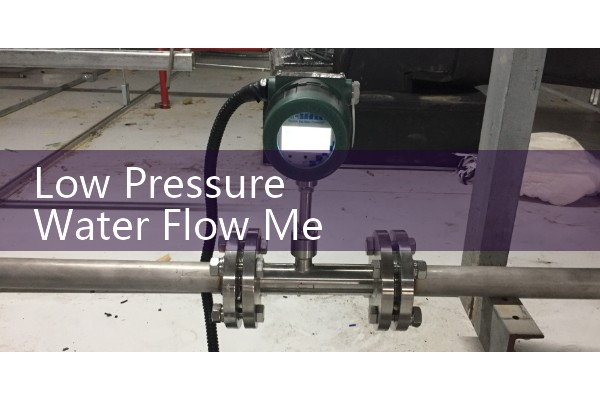
This is why low pressure systems in water treatment, food and beverage, and marine cooling often select full bore electromagnetic flow meters. The pump does not need to work harder. The gravity line keeps its driving head. The meter does not become the new bottleneck.
Installation Notes for Low Pressure Water Service
Keep the meter full of liquid. Do not mount an obstructionless magmeter at the highest point of a pipe where air can collect. For low pressure water, install the meter in a horizontal run or a rising vertical line. If the line may drain, use an empty pipe detection function or a flow switch.
Straight run requirements are shorter than those for orifice plates and turbine meters. Use 5D upstream and 2D downstream from a valve or elbow. Some Silver Instruments models accept 3D upstream with a mild flow disturbance. Always send the piping layout with your quote request.
For plastic pipes, ask for grounding rings. For buried installations, select IP68 remote sensors with submersible cable entries. For above ground water lines, IP67 is often enough.
Typical Specifications to Request
For low pressure potable water below 40 °C, request a flanged full bore magmeter with hard rubber liner, 316L electrodes, PN10 or PN16 flanges, 4-20 mA HART output, and pulse output. For water up to 80 °C, use a PTFE or PFA liner. For chlorinated water or aggressive process water, specify Hastelloy C electrodes and a PTFE liner.
Do not oversize the meter just to match the flange. A DN150 meter on a line that only needs DN80 can lose low flow accuracy. A DN80 meter with reducers may add a little head loss, but the flow range stays usable. Ask the supplier to calculate velocity, accuracy, and pressure drop together before you buy.
FAQ
What is the minimum line pressure for an obstructionless magmeter?
The meter can operate in a line pressure close to atmospheric as long as the pipe stays full. The key issue is not the meter itself. It is the required upstream head to keep velocity in the accurate range. In low pressure water systems from 0.2 bar to 0.5 bar, full bore magmeters work well when the pipe is full.
Does an in-line magmeter cause pressure drop?
An obstructionless full bore magmeter adds almost no pressure drop. It does not have a reduced bore or moving restriction. Minor friction loss over the meter length is normally less than 0.01 bar.
Can I install a magmeter in a gravity-fed water line?
Yes. Keep the meter flooded at all times. Install it in a low point or a horizontal section. Use a full bore design and match the meter size to the normal velocity. A gravity line at 0.25 bar can work if the velocity stays above 0.3 m/s.
What conductivity does the water need?
Standard models need at least 20 µS/cm. Most drinking water and process water meet this level. For demineralized water, condensate, or reverse osmosis permeate below 20 µS/cm, specify a magmeter rated for 5 µS/cm.
What parameters should I send for a low pressure water flow meter quote?
Send your pressure (bar), temperature (°C), pipe size (DN), flow range in m3/h, water type, and conductivity if known. Also include the piping material and whether the installation is buried or above ground.
Contact Silver Automation Instruments for obstructionless in-line magmeter sizing and price. Tel: +86-135-1213-1526. Whatsapp: 86-135-12131526. WeChat: +86 13512131526.