

 Current position > Product detail
『Soybean Oil Flow Meter 1/2 Inch: Fine-Tuning Precision Laboratory Formulations』Related information(clamp on meter|electromagnetic meter|venturi meterrotameter|orifice meter|ultrasonic flow meter|mass flow meter|coriolis mass flow meter|coriolis flow meter|magnetic flow meter|magmeter flow meter|magflow flow meter|mag meter flow meter|electromagnetic flow meter|vortex flow meter|turbine flow meter|thermal mass flow meter|thermal flow meter|rotameter flow meter)

Soybean Oil Flow Meter 1/2 Inch: Fine-Tuning Precision Laboratory Formulations
Quick Answer
A 1/2 inch (DN15) positive displacement flow meter delivers the repeatability a lab needs when dosing soybean oil into pilot-scale batches. Oval gear meters from Silver Instruments measure flows as low as 0.2 L/h at ±0.5% of reading, even when viscosity shifts with temperature. If your formulation work demands batch-to-batch consistency below 20 L/h, a DN15 oval gear meter with Pt100 temperature compensation is the pragmatic starting point.
Why Lab-Scale Soybean Oil Dosing Breaks Common Flow Meters
Soybean oil at 25 °C sits around 50 to 60 cP. That is not extreme. What causes trouble in a 1/2 inch line is the combination of low velocity, intermittent flow, and frequent start-stop cycles. A turbine meter simply will not spin reliably at 0.5 L/h. Thermal mass meters struggle because the oil does not conduct heat like water. In practice, many lab technicians first try a tiny electromagnetic meter, only to discover soybean oil is non-conductive. We have shipped replacement oval gear meters to three food R&D centres in Malaysia and Indonesia for precisely this reason. The common thread was a failed magmeter in a 1/2 inch line.
Why Positive Displacement Wins the 1/2 Inch Argument
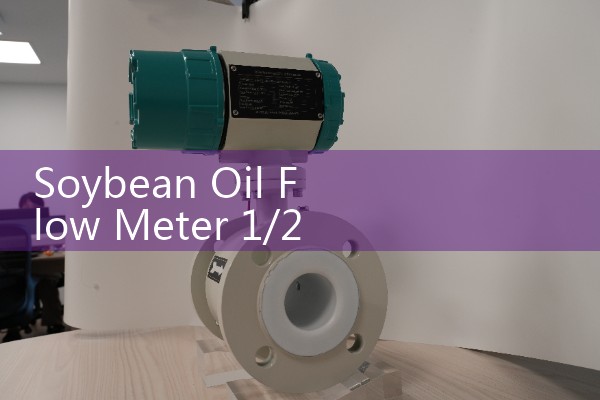
Oval gear meters measure volume directly. Two oval-shaped rotors sweep a precise, known volume with every rotation. Flow turbulence and Reynolds number just do not matter. The meter captures every pocket of oil, even during a slow ramp-up from zero. Silver Instruments supplies the OGM series in DN15 with hardened PPS gears and 316L stainless steel housing. A PT100 sensor embedded in the measuring chamber lets you correct volume to mass in real time. Because soybean oil density changes by roughly 0.64 kg/m³ per °C, that temperature signal turns a good volumetric reading into a precise mass total for your lab notebook.
Not All 1/2 Inch Oval Gear Meters Are Alike
Some low-cost miniature oval gear meters use brass chambers. Do not put soybean oil through brass for long. Even food-grade vegetable oil can oxidise and form free fatty acids that slowly attack copper alloys. Silver Instruments builds the DN15 meter with full stainless steel wetted parts and food-grade FFKM seals. The standard output is a pulse, but most labs need 4-20 mA HART to talk to a PLC or paperless recorder. We configure that at the factory. So you receive a loop-powered transmitter, ready for two-wire connection to a DIN-rail isolator or an analogue input card. This is not a prototype toy. It is a small industrial instrument, ATEX Zone 2 compliant by default, and happy running 8 hours a day in a fume hood.
Real Numbers from a Southeast Asian Food Lab
Last year a customer in Ho Chi Minh City approached Silver Instruments with a specific problem. They were formulating a low-fat spread and needed to add soybean oil at 1.2 L per 50 kg batch, with a tolerance of ±5 mL. The oil temperature varied from 22 °C in the morning to 28 °C after lunch. We proposed a DN15 oval gear meter with an integrated Pt100, set to output mass flow via the HART variable mapping. The lab ran a 30-batch trial. Coefficient of variation on oil mass dropped from 2.1 % to 0.45 %. That result meant they could tighten the product specification without reformulating the entire recipe. Most engineers skip this part: the master batch record now carries the silver instrument tag number as the reference metering device for oil dosing. That is the kind of traceability
Installation Pointers for Repeatability Below 2 L/h
Keep the meter full. A pocket of air trapped in an oval gear chamber destroys repeatability. Install the meter low in the line, ideally with an upward flow path so bubbles vent naturally. Use a Y-strainer with a 100-mesh screen upstream. Soybean oil drawn from a drum often carries tiny sediment or polymerised flakes. That debris can jam the oval gears. The strainer is cheap insurance. Pipe vibration kills low-flow accuracy. Mount the DN15 meter on a rigid bracket, not hanging in mid-air. Because the meter body is small, a short piece of flexible hose on the inlet side can isolate vibration from a peristaltic pump. That simple fix has doubled the stable measurement window on several customer sites.
When to Consider a Mini Coriolis Meter for Soybean Oil
If your lab also measures solvents, flavours, or volatile carriers that change density unpredictably, a mini Coriolis mass flow meter makes more sense. Silver Instruments offers the CMF-DN6 and CMF-DN10 for sub-kilogram-per-hour ranges. Coriolis meters give you direct mass flow, density, and temperature with one device. The trade-off is higher initial cost and a slight sensitivity to installation stress. For soybean oil alone, a DN15 oval gear meter with temperature compensation delivers 90 % of the capability at roughly one-third the price. But if your line handles six different fluids, a single mini Coriolis meter is the tool that keeps the lab schedule from stalling.
FAQ
Which flow meter type fits soybean oil in a 1/2 inch laboratory line?
A positive displacement oval gear meter. It measures volume directly, ignores fluid conductivity, and repeats within ±0.5 % even at 0.5 L/h.
Can a DN15 oval gear meter from Silver Instruments handle food-grade oil up to 60 °C?
Yes. The standard stainless steel chamber and FFKM seals are rated for 80 °C continuous. For higher temperatures, tell us your exact process conditions and we select the right seal grade.
Do I need a Pt100 temperature sensor for soybean oil dosing?
If your process control is volumetric only, you can skip the Pt100. But if you record mass in kilograms and your lab temperature swings more than 5 °C during a shift, the Pt100 pays for itself in data consistency.
What flow range can I expect from a 1/2 inch oval gear meter?
With soybean oil at 50 cP, the typical linear range is 0.2 L/h to 30 L/h. Maximum intermittent flow can touch 60 L/h, but sustained operation near the top end will shorten seal life.
Are the wetted parts compatible with CIP (clean-in-place) for a pilot plant?
The OGM-DN15 is not designed for steam-in-place sterilisation. Mild caustic wash at 60 °C is acceptable. For daily CIP with hot chemicals, ask about our sanitary oval gear meter with EHEDG elastomers.
How to Get a Meter Sized for Your Soybean Oil Recipe
Send us your target flow rate (L/h or kg/h), oil temperature (°C), pipe size (DN), and the PLC analogue input type you prefer (4-20 mA, pulse, or HART). We will reply with a datasheet, a dimensional drawing, and a quote for the exact OGM or CMF model that fits your lab bench. Because Silver Automation Instruments stocks the DN15 oval gear meter in Australia, we can ship to Singapore, Bangkok, Auckland, and Dubai within five working days. Many labs start with one unit for a critical dosing point and add more once the batch records improve. That approach works.