


『Clamp On vs Inline Flow Meter: Installation Cost vs Liquid Contact Sizing』Related information(clamp on meter|electromagnetic meter|venturi meterrotameter|orifice meter|ultrasonic flow meter|mass flow meter|coriolis mass flow meter|coriolis flow meter|magnetic flow meter|magmeter flow meter|magflow flow meter|mag meter flow meter|electromagnetic flow meter|vortex flow meter|turbine flow meter|thermal mass flow meter|thermal flow meter|rotameter flow meter)

Clamp On vs Inline Flow Meter: Installation Cost vs Liquid Contact Sizing
Quick Answer: Clamp-on flow meters cost less to install on large lines and on pipes that cannot be shut down. Inline flow meters give better accuracy and repeatability when the liquid is dirty, hot, low conductivity, or non-homogeneous. Quote both styles only after you know pipe size, fluid type, flow range, pressure, and temperature.
Installation Cost Starts With Downtime, Not Hardware
Most engineers skip this part. The meter price is one line in the quote. The bigger risk is process downtime. A clamp-on meter on a DN150 cooling water line in Vietnam took 40 minutes to install. The same DN150 line would need 4 to 7 hours of downtime for an inline meter with flanges and welding. If the plant loses USD 900 per hour in production, the clamp-on install avoids USD 3,600 to USD 6,300 in lost output.
That number changes by country. In the Philippines, a two-person instrument crew charges less than a crew in Australia. But welding and pipe fitter costs are similar in many plants. We have seen this on customer sites many times. Inline installation needs pipe cutting. The job also needs flange alignment, gaskets, bolts, crane access, and maybe hot work permits. Clamp-on installation needs clean pipe surface, coupling gel, and transducer mounting rails.
Clamp-On Installation Cost in Real Numbers
For a DN100 to DN200 carbon steel line, a clamp-on ultrasonic flow meter from Silver Instruments often installs in under one hour. Labor cost can be USD 300 to USD 1,200 in Southeast Asia or the Middle East. No pipe cutting. No process shutdown. No gaskets. No welding. The main hidden costs are surface preparation, temporary local flow calibration, and sometimes a pipe wall thickness gauge.
The catch is pipe condition. The pipe must be full. The outside wall must be clean. Heavy scale or rust reduces signal. For old buried lines or lines with internal deposits, clamp-on accuracy drops. In practice, we ask for pipe material, wall thickness, liner type, and fluid before quoting. A DN50 thin-wall stainless line in a food plant is easy. A DN400 concrete-lined wastewater pipe is difficult.
Inline Installation Cost Hides in Mechanical Work
Inline meters look simple. You cut the pipe. You weld flanges or mount a wafer in the line. You attach grounding rings and cable. But the cost is not only the meter. A DN80 electromagnetic flow meter on a chemical line in Indonesia needed two welders, one pipe fitter, and a hot work permit. Total installation time was 5 hours. The meter price was lower than the full installed cost.
For larger lines, DN300 and above, inline meters add weight. You need lift equipment. You may need pipe supports. Flange alignment on a DN400 desalination line can take half a day. The mechanical work often costs more than the meter itself. That is why we ask customers to compare total installed cost, not just unit price.
Liquid Contact Sizing Changes Everything
Here is the thing. Inline meters contact the liquid directly. Sizing depends on wetted materials, liner, electrodes, viscosity, and pressure drop. A clamp-on ultrasonic meter does not contact the liquid. You avoid material compatibility problems. You avoid liner failure. You avoid pressure drop. But you also lose signal on bubbly or high-solids liquids.
For clean water, a clamp-on meter works from DN50 to DN1200. Below DN25, clamp-on signal quality drops fast. Small pipe wall effects dominate. So for a DN15 chemical feed line, we do not quote clamp-on. We quote an inline electromagnetic flow meter or a small oval gear meter. For DN200 cooling water, clamp-on is the strongest first quote.
Inline electromagnetic flow meters need conductivity above 5 µS/cm. For ultra-pure water at 0.1 µS/cm, electromagnetic does not work. A clamp-on ultrasonic meter can work if the pipe is full and the wall is not lined with thick rubber. Coriolis mass flow meters handle high viscosity and non-conductive liquids. Oval gear meters handle high viscosity oils from DN15 to DN50.
Where Clamp-On Meters Are the Right Quote
Clamp-on flow m
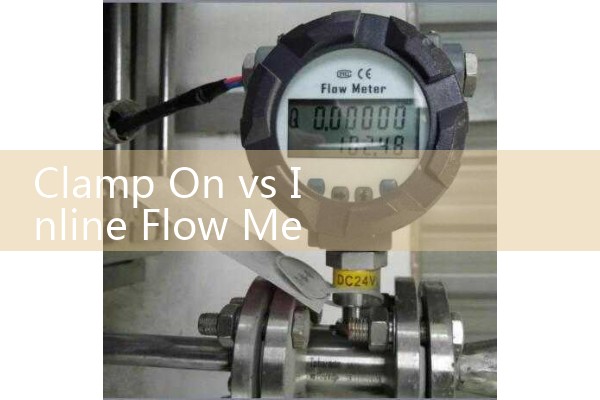
Common clamp-on applications include cooling water, chilled water, HVAC headers, pump performance checks, desalination feed water, and wastewater effluent. They are also used for temporary flow surveys. In the Middle East, customers use clamp-on meters for DN300 and DN400 lines where inline meter weight and shutdown cost are too high.
Where Inline Meters Are the Safer Quote
Inline meters earn their cost on difficult liquids. A chemical plant in Mexico needed to measure a corrosive acid at 120 °C. The liquid had low pH and high conductivity. An inline electromagnetic flow meter with PTFE liner and tantalum electrodes was the safe choice. Clamp-on would not touch the liquid, but the pipe liner and high temperature would hurt the signal.
Other inline situations include crude oil at 800 cP, food and beverage CIP cycles, slurries with 10 percent solids, batch dosing on DN15 to DN40 lines, and any line below DN25. For high viscosity, an oval gear flow meter is better than clamp-on. For mass flow in kg/h, a Coriolis mass flow meter is better.
Model Pairing Specs That Help You Compare
Silver Instruments clamp-on ultrasonic flow meter fits DN50 to DN1200. Accuracy is around ±1.0 percent of reading on clean liquids. Output options include 4-20 mA HART, RS485 Modbus, and pulse. Optional PT100 input is available. Temperature rating is -20 °C to 120 °C on the pipe surface.
Silver Instruments electromagnetic flow meter fits DN10 to DN600. Accuracy is ±0.5 percent of reading. Liners include PTFE, rubber, and ceramic. Electrodes include 316L, Hastelloy, tantalum, and titanium. For sanitary food lines, we quote a stainless body and tri-clamp connections. For chemical lines, we quote a PTFE liner and tantalum electrodes. Pressure ratings from PN16 to PN40 cover most plant lines. ATEX Zone 1 housing is available for hazardous areas.
Five Most Critical Questions
Q: How fast can a clamp-on meter be installed on a DN200 pipe?
A: A two-person team can often install a clamp-on ultrasonic meter in 30 to 60 minutes on a clean DN200 carbon steel pipe. The line must be full. The pipe wall must be consistent.
Q: When is an inline electromagnetic flow meter better than clamp-on?
A: Inline electromagnetic is better for liquids with conductivity above 5 µS/cm, temperatures above 120 °C, aggressive chemicals, and lines below DN50. It is also better when you need ±0.5 percent accuracy.
Q: Does clamp-on work on all pipe materials?
A: No. It works well on carbon steel, stainless steel, and some plastic pipes. Thick concrete, rubber liners, and heavily scaled pipes weaken the signal. Always share pipe material and liner type with us.
Q: What is the main hidden cost of inline installation?
A: The hidden cost is mechanical work. Cutting, welding, flange alignment, lift equipment, hot work permits, and downtime add more than the meter price on many DN150 and larger lines.
Q: Which meter should I choose for a DN15 chemical dosing line?
A: Do not use clamp-on. Use an inline electromagnetic flow meter or an oval gear flow meter. For a conductive chemical with 4-20 mA HART output, the electromagnetic option is usually the best fit.
Get a Quote With Real Numbers
Silver Automation Instruments is a flow meter manufacturer and supplier. We have supported customer sites in Vietnam, the Philippines, Indonesia, Mexico, the UAE, and Nigeria. Send us your pressure (bar), temperature (°C), pipe size (DN), and flow range. If the pipe cannot be shut down, tell us that too. We will quote the clamp-on and inline option side by side with total installed cost in mind.
Tel: +86-135-1213-1526. Whatsapp: 86-135-12131526. WeChat: +86 13512131526.
 Hot Product
 Related AD
